
Psychiatrist vs Psychologist vs Therapist: Where to Start
You’ve decided to get help for your sleep, your mood or your nerves. Then comes the first question: who? Psychiatrist. Psychologist. Therapist. The titles sound alike, yet the training behind each is different, and so is the care. Starting with the wrong one rarely causes harm, but it can cost weeks. This guide explains psychiatrist vs psychologist vs therapist in plain terms and where to begin.
According to Dr. Prakhar Jain, Psychiatrist in Mumbai, “The three titles describe three kinds of training. A psychiatrist is a medical doctor. That means medicines and physical checks are part of the job. Psychologists and therapists work mostly through assessment and conversation. Many people need a mix, and starting with any of the three is a reasonable first step.”
What Does Each Professional Do?
Picture three toolboxes. Each holds different tools.
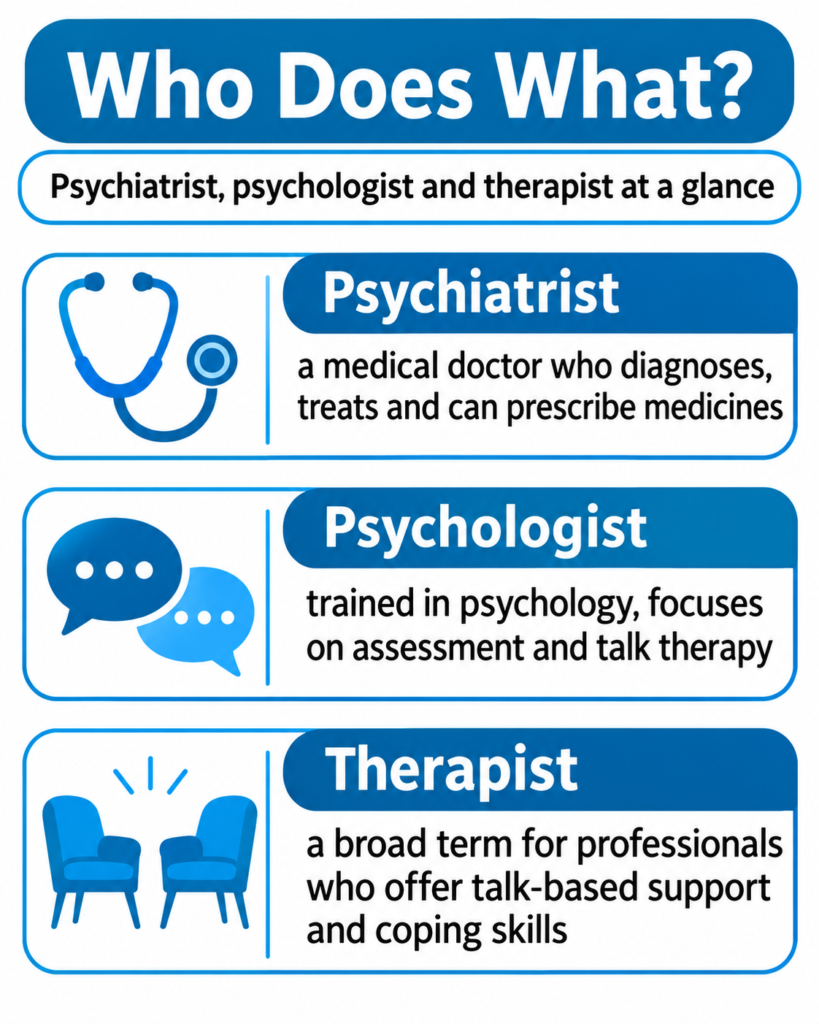
- A first visit with a psychiatrist: They’ll ask what’s been happening. How you sleep, how you eat, who in the family has had similar trouble, what you already take. Physical health comes up too.
- A first visit with a psychologist: More talk about your thoughts, habits and past. There may be a short form to fill in. Regular, planned sittings usually follow.
- A first visit with a counsellor: It’s mostly talk. You say what has been hard, and the two of you pick something to work on.
- Why the titles blur: Nobody owns the word “therapist”. A psychologist may use it. A counsellor or social worker might too. So ask about training and registration.
If low mood is the worry, this page on depression treatment shows what a medical assessment covers.
Psychologist vs Psychiatrist for Depression: What Helps?
Take depression as the example. Here is how the roles compare.
|
Aspect |
Psychiatrist |
Psychologist |
Therapist |
|
Training |
Medical degree plus psychiatry training |
Degree in psychology, often with clinical training |
Varies; includes counsellors and social workers |
|
Medication |
Yes |
Not in most places |
Usually no |
|
Treats mainly with |
Drugs and therapy |
Talk therapy and tests |
Counselling |
|
First choice when |
Symptoms are severe |
You want an assessment |
You want ongoing support |
- For depression: Both help. Therapy works on thinking. A thought like “I’m useless” gets looked at and tested. Medicine eases the physical side: low energy, poor sleep, no appetite.
- What the research says: Across 52 trials, patients given both therapy and antidepressants did better than patients given antidepressants alone. That held for depression and anxiety. The gain was still there at follow-up.
- Who handles the drugs: In most places only a medical doctor can, and that includes India. A few US states let specially trained psychologists do it, but that’s the exception.
- Working as a team: Seeing both is common. One manages the pills. The other handles the talking. They compare notes.
When the usual options haven’t been enough, the post on rTMS treatment for depression covers another route.
Who Should You See First, and When?
No rule fits everyone. A few signs help.

- What only a psychiatrist can do: Prescribe drugs. Order blood tests. Check for side effects. A therapist’s role doesn’t cover these.
- Why physical health matters: Not every low mood starts in the mind. An underactive thyroid can slow you down and flatten your mood. A vitamin shortage can feel like anxiety. A blood test helps tell them apart.
- If you’re unsure: Book the first appointment available. Waiting for the perfect match costs weeks. At the wrong door, a good professional will say so and point you onward.
- If you’re in crisis: Thoughts of harming yourself or others need help today. Don’t wait for an appointment. Call emergency services or a crisis helpline, or go to the nearest hospital.
Already taking tablets? One option is pharmacogenomic testing. A DNA sample is checked for genes that affect how drugs work in your body.
Key Takeaways: A psychiatrist is a medical doctor who can prescribe medicines and order tests. A psychologist works through assessment and talk therapy. “Therapist” is a general title, so ask about training and registration. Many people see both, and combined treatment did better than medication alone in the trials reviewed. Unsure where to begin? Book the first appointment available. In a crisis, seek emergency help at once.
Not sure which professional to start with?
FAQs
Who should I consult first, a psychologist or a psychiatrist?
Either can start. Psychiatrist if symptoms are severe or you may need drugs.
What can a psychiatrist do that a therapist cannot?
A psychiatrist is a medical doctor, so they prescribe drugs and order tests.
When should you see a psychiatrist or a psychologist?
Psychologist for therapy or assessment. Psychiatrist for drugs, diagnosis or severe symptoms.
Psychologist vs psychiatrist for depression: who helps?
Both help. Combined treatment worked better than tablets alone in trials.
Reference
- Adding psychotherapy to antidepressant medication in depression and anxiety disorders: a meta-analysis. World Psychiatry. 2014;13(1):56-67. PMC3918025.
- Demographics and Clinical Characteristics of Patients of Prescribing Psychologists, Psychiatrists, and Primary Care Physicians. Am Psychol. 2024;80(5):729-743. PMC11881088.
Disclaimer: This blog is for educational and informational purposes only and should not be considered professional advice.

MBBS, M.D. (PSYCHIATRY), PDF, EMH (USA)
Child & Neuro Psychiatrist.
Dr. Prakhar Jain is a Psychiatrist in Mumbai, and has an experience of more than 13 years in this field. Dr. Prakhar Jain practices at Breach Candy Hospital, Bombay Hospital & Grace Medical Centre in Mumbai. He completed MBBS from Indira Gandhi Government Medical College, Nagpur and M.D. (Psychiatry) from Grant Medical College and Sir JJ Hospital, Mumbai.
Several anxiety disorders commonly occur independently of depression.