
Sensory Processing Disorder and Autism: What's the Link?
Right now your brain is sorting a dozen things you haven’t noticed. A fan humming. The tag on your collar. The light overhead. Most of us never notice the sorting. It just happens. Sensory processing disorder (SPD) is what you get when that sorting breaks down. Some brains amplify everything, and others hardly pick anything up. So one child winces at the school bell while another walks off a scraped knee without a word. Sensory differences are part of the autism criteria as well. Naturally, parents ask how the two connect. Here’s how the pieces fit.
According to Dr. Prakhar Jain, Psychiatrist in Mumbai, “A child who covers their ears or refuses certain clothes is not being difficult. Their brain may be handling that input very differently, and seeing it that way changes how a family responds.”
What Do Sensory Problems Look Like in a Child With Autism?
At home, it often starts with something as small as a sock.
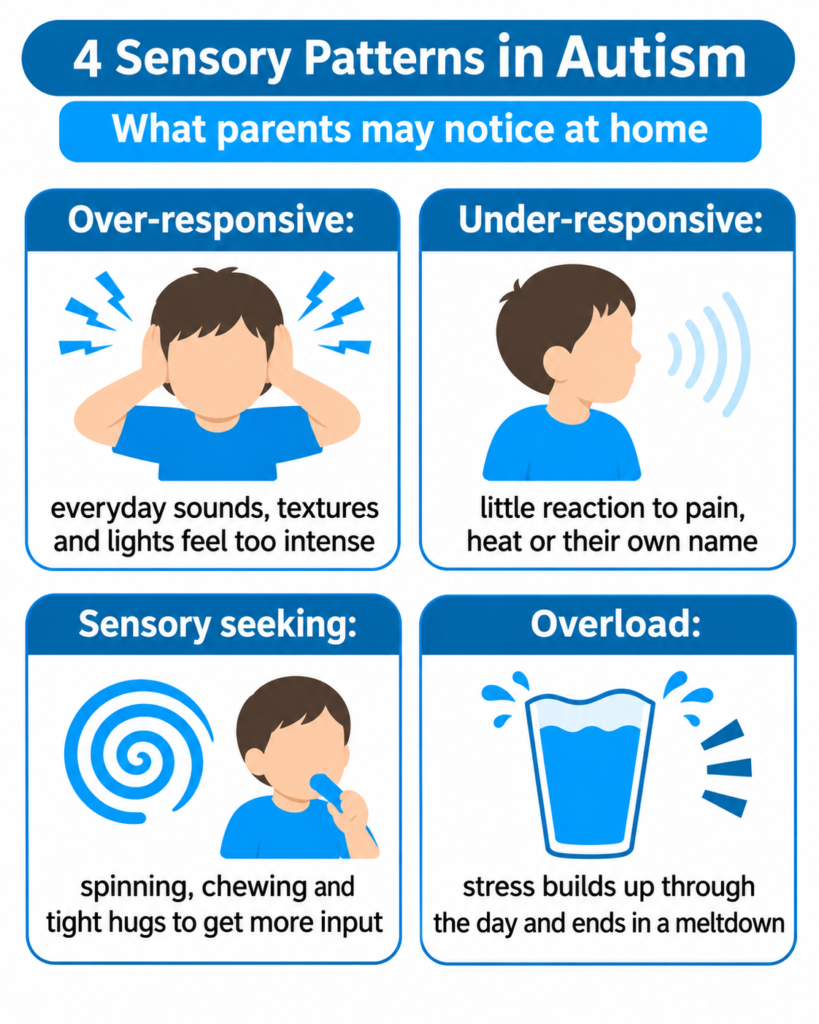
- Mornings at home: Getting dressed is often the first fight. A seam, a label, a stiff collar. Even toothpaste can taste too strong.
- At school: The bell, the canteen, assembly in a packed hall. By the afternoon some children are worn out before the lessons even start.
- Mealtimes: The diet gets narrow. Same brand, same crunch, nothing mixed. A soft or slippery texture can bring on gagging.
- Bedtime: Winding down is hard when the sheets feel wrong or the fridge hums. Sleep problems and sensory problems often travel together.
Families who have reached the point of wanting answers can read what an assessment involves on the autism therapy and assessment page.
How Does SPD Relate to Autism, and Where Do They Differ?
Here’s how sensory processing disorder in autism compares with SPD on its own.
Aspect | SPD | Autism spectrum disorder |
Core feature | Difficulty processing and responding to sensory input | Differences in social communication plus restricted or repetitive behaviours |
Sensory differences | The central problem | One part of the diagnostic criteria |
Social communication | Not a defining feature, though sensory stress can affect comfort | Affected by definition |
Repetitive behaviours | Not a defining feature | A defining feature |
Diagnostic status | Not listed as its own diagnosis in DSM-5; usually called sensory processing difficulties | Formal diagnosis with set criteria |
- Shared ground: Sensory reactivity counts as one of the criteria used to diagnose autism. So plenty of autistic children show what looks exactly like SPD.
- Key difference: Autism goes further. There are differences in social communication too, along with repetitive behaviours. Sensory problems don’t explain those.
- Early impact: Studies tie early sensory problems to social difficulty. No surprise there. A noisy playground makes joining in very hard.
- Not always together: SPD-type difficulties also show up with ADHD and other developmental conditions. So a sensory problem by itself doesn’t prove autism.
Parents often mix up sensory overload and inattention: the guide on autism vs. ADHD differences shows how to tell them apart.
How Can You Ease Sensory Issues in Children?
There’s no magic fix, but small changes at home and school add up.

- Watch for triggers: Jot down when the hard moments happen. Time, place, noise, who was there. Patterns show up faster than you’d expect.
- Give them a signal: A hand sign or a small card that says “too loud” gives a child a way out before things boil over.
- Tell the school: Share what you’ve noticed. A seat away from the door, a quiet corner or a warning before the bell can make a school day easier.
- Stay calm in the moment: When a child is overloaded, use a low voice and few words. Skip the questions and the lecture. Talk once they’ve settled.
For ideas to try this week, see the guide to occupational therapy at home for autism and ask a clinician if you need more.
Key Takeaways: SPD is a problem with handling sensory input. Autism is broader. Sensory trouble is only one piece of it. Covering ears, refusing certain textures or craving constant movement are worth a conversation with a clinician. Many children cope better with steady routines and the right support, and symptoms often ease with age.
Does your child get upset by loud rooms, itchy clothes or crowds in ways other kids don’t?
FAQs
How does SPD relate to autism?
They overlap. Autism includes sensory problems. SPD can also appear alone.
What are some signs that someone with autism might have sensory problems?
Covering ears. Gagging at textures. Constant spinning. Meltdowns in busy places.
Can a child outgrow SPD?
Many do. Improvement comes with time and therapy. Some traces may stay.
How to solve sensory issues in children?
Calm surroundings and routines first. Therapist-led practice if that isn’t enough.
Reference
Disclaimer: This blog is for educational and informational purposes only and should not be considered professional advice.

MBBS, M.D. (PSYCHIATRY), PDF, EMH (USA)
Child & Neuro Psychiatrist.
Dr. Prakhar Jain is a Psychiatrist in Mumbai, and has an experience of more than 13 years in this field. Dr. Prakhar Jain practices at Breach Candy Hospital, Bombay Hospital & Grace Medical Centre in Mumbai. He completed MBBS from Indira Gandhi Government Medical College, Nagpur and M.D. (Psychiatry) from Grant Medical College and Sir JJ Hospital, Mumbai.
Several anxiety disorders commonly occur independently of depression.