What Is Transcranial Direct Current Stimulation Used For?
A tDCS session looks simple. Two small electrodes on the scalp. A weak, steady current, usually one to two milliamps. You’d barely notice anything else. The technique is called transcranial direct current stimulation (tDCS). Brain stimulation, yes, but non-invasive. The current doesn’t set off nerve impulses itself. It changes how primed neurons are, so each is slightly more or less likely to fire. The obvious next question is what tDCS uses actually include. This blog walks through them.
According to Dr. Prakhar Jain, Psychiatrist in Mumbai, “Think of tDCS as turning a dial, not flipping a switch. It changes how ready brain cells are to respond, which is why it is studied as one part of care and not as a stand-alone cure.”
How Does tDCS Work?
No needles. No surgery. A small current doing quiet work.
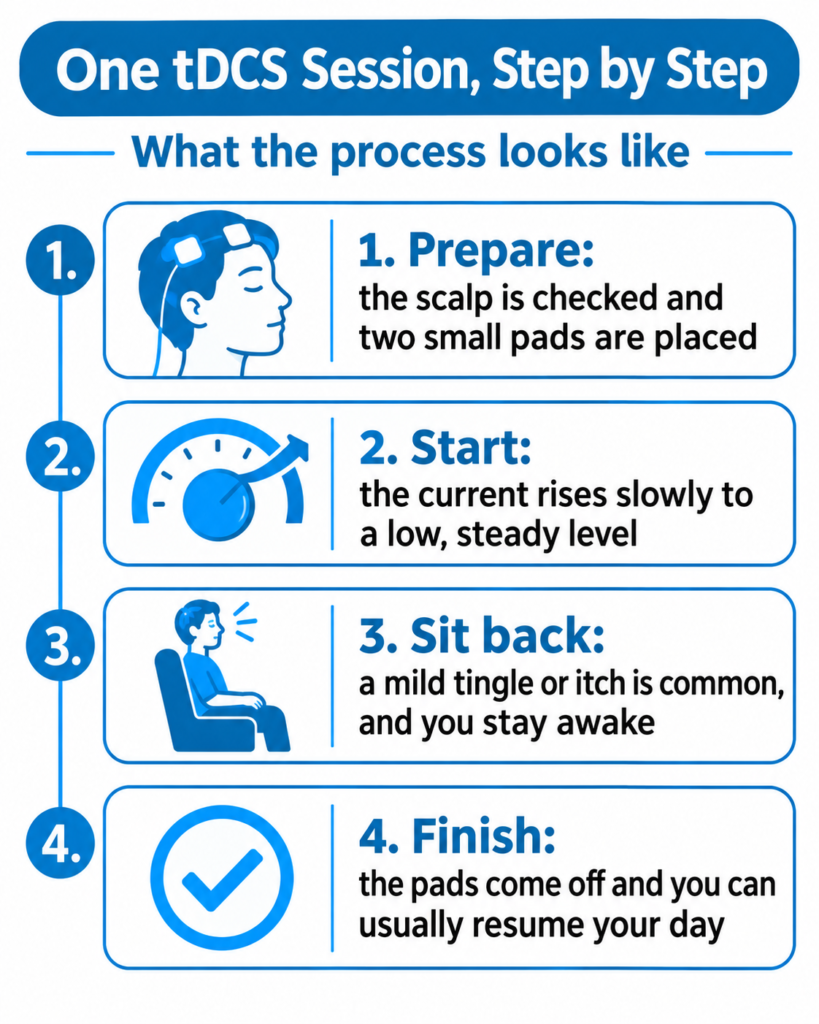
- Two electrodes, two roles: The current enters at the anode and leaves at the cathode. Under the anode, neurons tend to become easier to fire. Under the cathode, the opposite tends to happen.
- Placement decides the target: Where the pads go matters. For depression, the anode is usually placed over the left front of the head, which is linked to mood. Shift the pads and you reach a different region.
- One session is rarely enough: A single sitting rarely does much. Whatever changes tends to fade. So treatment is given as a course, and the effect can add up over time.
- Anatomy changes the dose: Every head is different. Skull thickness and brain shape change how the current spreads. Two people on the same setting can respond differently.
For how the treatment is offered, see the transcranial direct current stimulation (tDCS) page.
What Is tDCS Used For?
The list of studied conditions is long. The firmest support sits with depression.
Condition | What research suggests | Strength of support |
Depression | Guidelines rate left prefrontal tDCS as effective | Strongest |
Chronic pain | Fibromyalgia, neuropathic pain and migraine rated probably effective; relief was short-lived in one analysis | Moderate to low |
Stroke recovery | Movement recovery rated probably effective; speech problems possibly | Moderate to low |
Other conditions | Hallucinations in schizophrenia, alcohol craving, OCD and epilepsy have been studied | Early to moderate |
- Is tDCS really effective?: It depends on the condition. A guideline review rated it effective for depression. For most other uses the wording is “probably” or “possibly”. Effect sizes in the studies ranged from very small to moderate.
- A major disadvantage of tDCS: The benefit can be small, and it can wear off. Many trials involve few patients. Their findings don’t always agree.
- Side effects: Usually mild. Common ones: tingling, itching, redness of the skin, headache, tiredness. One meta-analysis covered 22 trials and reported no serious complications.
- A supporting role: Authors of a pain review describe it as a short-term option. Not a stand-alone treatment.
The magnetic method works differently. This post on transcranial magnetic stimulation explains how.
How Long Do tDCS Effects Last, and What Does It Cost?
Two questions every patient asks. Neither has one answer.

- How long effects last: It depends on the condition. In pooled chronic pain trials, relief faded after about a week. The depression benefit held through follow-up. Guideline authors also point out that effects are often limited in duration.
- Why it varies: Three things shape it: the condition, the number of sessions and the person’s own anatomy. So does any other care running alongside.
- What a course may cost: No fixed price exists. Sessions, protocol, centre and supervising staff all move it. Get the full course estimated in writing.
- Screening comes first: Some things need extra care: metal or electronic implants in the head, a history of seizures, skin problems under the pads. A clinician checks before the first sitting.
For low mood in particular, the depression treatment page shows how a doctor assesses it.
Key Takeaways: In short: tDCS sends a weak current that makes brain cells slightly easier or harder to fire. Depression has the firmest support. Pain, stroke recovery and some other conditions have weaker, mixed evidence. Effects vary and may fade. Side effects are usually mild. Price follows the course planned. A psychiatrist can say whether it fits.
Curious whether this could apply to a specific condition?
FAQs
Which is a major disadvantage of tDCS?
Results can be modest and short-lived, and vary by person.
How much does tDCS therapy cost?
Prices differ. It depends on sessions, protocol and centre. Request a written estimate.
How long do tDCS effects last?
Depends on the condition. Pain relief faded after a week; depression gains held longer.
Is tDCS really effective?
Guidelines rate it effective for depression. Elsewhere the evidence is thinner.
Reference
- Evidence-Based Guidelines and Secondary Meta-Analysis for the Use of Transcranial Direct Current Stimulation in Neurological and Psychiatric Disorders. Int J Neuropsychopharmacol. 2021;24(4):256-313. PMC8059493.
- Is transcranial direct current stimulation beneficial for treating pain, depression, and anxiety symptoms in patients with chronic pain? A systematic review and meta-analysis. Front Mol Neurosci. 2022;15:1056966. PMC9752114.
Disclaimer: This blog is for educational and informational purposes only and should not be considered professional advice.

MBBS, M.D. (PSYCHIATRY), PDF, EMH (USA)
Child & Neuro Psychiatrist.
Dr. Prakhar Jain is a Psychiatrist in Mumbai, and has an experience of more than 13 years in this field. Dr. Prakhar Jain practices at Breach Candy Hospital, Bombay Hospital & Grace Medical Centre in Mumbai. He completed MBBS from Indira Gandhi Government Medical College, Nagpur and M.D. (Psychiatry) from Grant Medical College and Sir JJ Hospital, Mumbai.
Several anxiety disorders commonly occur independently of depression.